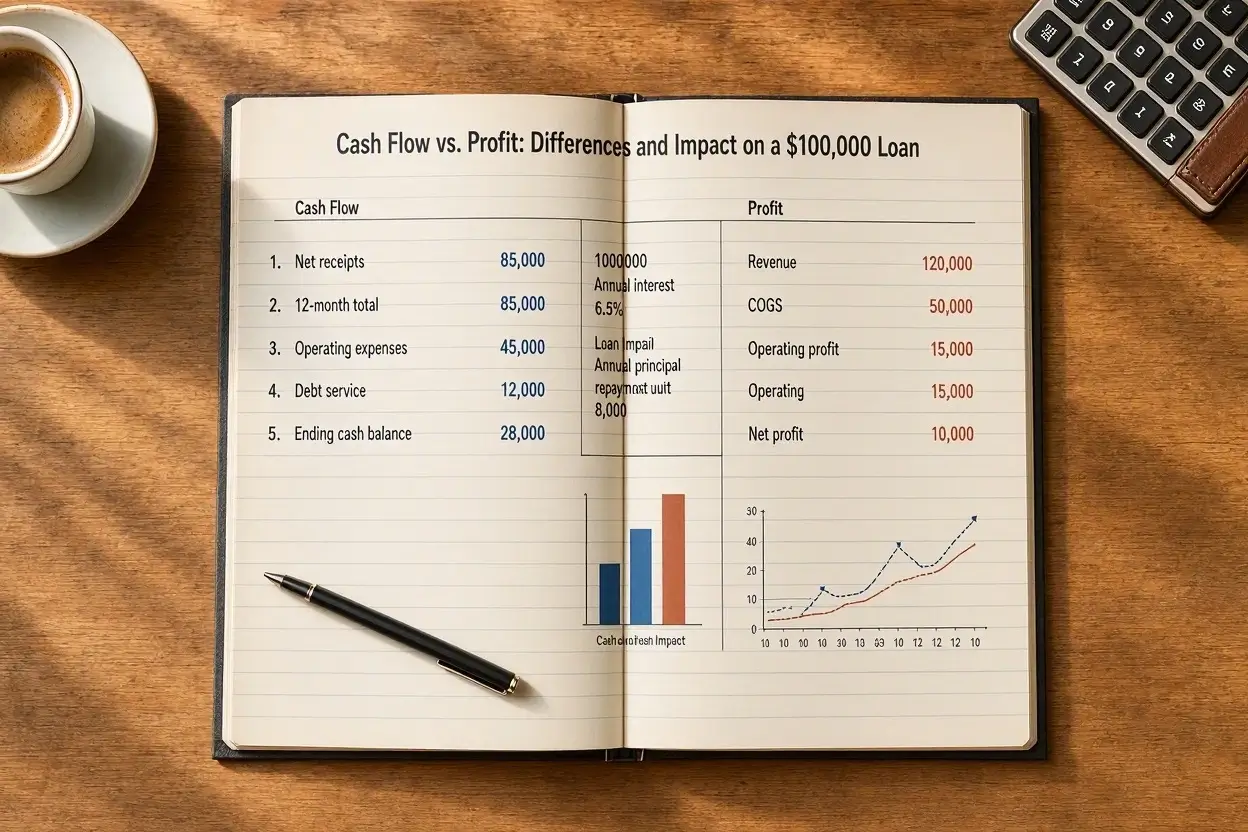
Cash Flow vs. Profit: Differences and Impact on a $100,000 Loan
Cash Flow vs. Profit: What’s the Difference and How Does It Affect a $100,000 Small Business Loan?
A foundational paradox exists within corporate finance: a small business can be highly profitable on paper yet still go completely bankrupt. Conversely, an enterprise can generate millions of dollars in continuous revenue transactions while failing to show a single dollar of net income at the end of the fiscal year.
For founders navigating day-to-day operations, conflating profit with cash flow is a critical error. While both metrics measure financial performance, they evaluate entirely different operational mechanics.
Understanding this distinction becomes vital when seeking mid-tier commercial capital, such as a $100,000 small business loan. Bank underwriters, digital lenders, and the Small Business Administration (SBA) view profit and cash flow through distinct lenses. This guide breaks down the structural differences between these two financial concepts and details exactly how they influence your approval odds and repayment capacity for a $100,000 debt facility.
⚖️ Direct Comparison: Cash Flow vs. Profit
| Feature | Cash Flow | Profit (Net Income) |
|---|---|---|
| Core Definition | The net amount of actual cash moving into and out of a bank ledger during a specific window. | The financial gain remaining after deducting total operating expenses from aggregate gross revenue. |
| Accounting Basis | Cash-basis accounting (tracks real-time liquidity changes). | Accrual-basis accounting (matches revenue earned to expenses incurred). |
| Primary Financial Statement | Statement of Cash Flows | Income Statement (Profit & Loss / P&L) |
| Core Purpose | Measures immediate operational liquidity and near-term solvency. | Measures long-term commercial viability and business sustainability. |
| Lender Assessment | Determines daily ability to make monthly loan payments. | Determines overall enterprise value and debt safety margins. |
🔍 Defining the Financial Pillars
Understanding Cash Flow: The Metric of Solvency
Cash flow tracks the physical movement of money. It is the literal ledger balance available to settle debts, purchase raw inventory, run payroll, and pay utility bills on any given day.
Cash flow operates dynamically across three distinct categories:
- Operating Cash Flow: Money generated or consumed by core commercial activities (e.g., selling goods, paying suppliers).
- Investing Cash Flow: Capital deployed for or received from long-term asset adjustments (e.g., purchasing a corporate vehicle or selling real estate).
- Financing Cash Flow: Cash flowing between the enterprise and its lenders or investors (e.g., receiving loan proceeds or paying equity dividends).
Positive cash flow means your liquid capital is increasing, giving you the runway to meet immediate liabilities. Negative cash flow indicates your business is burning through cash reserves faster than money is arriving, creating an immediate threat of insolvency—even if sales are thriving.
Understanding Profit: The Metric of Viability
Profit, or net income, is a structural accounting calculation. It is what remains after your total cost of goods sold (COGS) and operational overhead are subtracted from your total gross sales.
Unlike cash flow, profit is heavily influenced by non-cash accounting entries, such as depreciation, amortization, and accounts receivable. Under accrual accounting rules, if you sign a contract to deliver $50,000 worth of consulting services to a corporate client who has 60 days to pay, your Income Statement registers that $50,000 as revenue immediately. Your profit spikes. However, until that client cuts a check and the funds clear, your cash flow remains entirely unaffected.
📊 How Both Metrics Impact a $100,000 Small Business Loan
When an underwriter reviews a funding request for a $100,000 loan package, they do not favor one metric over the other. Instead, they cross-reference them to evaluate risk. A $100,000 loan introduces substantial fixed overhead—typically requiring monthly payments between $2,000 and $3,500 depending on the term (e.g., 3 to 5 years) and prevailing interest rates.
Here is exactly how lenders analyze both metrics during the credit evaluation process:
1. The Underwriter’s Primary Focus: Debt Service Coverage Ratio (DSCR)
Lenders use profit as a starting point to calculate your Debt Service Coverage Ratio (DSCR), but they quickly adjust it to reflect actual cash generation. The baseline formula for DSCR looks at Net Operating Income divided by Total Debt Service.
To find your true capacity to handle a $100,000 facility, underwriters look at EBITDA (Earnings Before Interest, Taxes, Depreciation, and Amortization). Because depreciation and amortization are non-cash expenses that lower paper profit, lenders add them back to your net income. They want to see a minimum DSCR of 1.25x. This means for every $1,000 in monthly payment obligations created by the new $100,000 loan, your adjusted cash flow must generate at least $1,250 in clear profit cushion.
2. The Danger of the “Profitable but Broke” Enterprise
Consider a growing e-commerce or manufacturing firm that applies for a $100,000 facility. Their tax returns show $150,000 in net profit. On paper, they look like an ideal candidate.
However, a deep dive into their bank statements reveals that their capital is entirely trapped in unpaid invoices (Accounts Receivable) and unsold warehouse stock (Inventory). They have less than $2,000 of liquid cash on hand at any given moment.
If this business encounters a minor delay in client collections, it will lack the daily liquidity to make its monthly loan payment. Traditional commercial lenders will routinely reject highly profitable businesses if their operational cash flow patterns are too volatile to guarantee timely loan payments.
3. The Startup Dynamic: Cash Flow Deficits with Strong Loan Viability
Conversely, early-stage SaaS firms, medical practices, or tech startups often show net profit losses on their P&L sheets due to heavy upfront investments in R&D, equipment depreciation, or rapid hiring.
If these companies can demonstrate a high, predictable stream of recurring cash flow (such as monthly subscription revenues or immediate point-of-sale cash clearings), alternative lenders or SBA lenders may still approve a $100,000 loan. The presence of steady, predictable cash inflows provides confidence that the loan can be serviced, even if the business is intentionally suppressing short-term paper profit to fuel rapid expansion.
🛠️ Action Plan: Balancing Metrics to Secure Your Capital
To maximize your approval odds for a $100,000 loan, you must demonstrate structural strength in both financial arenas. Use this tactical approach to optimize your financial profile before submitting a loan application:
- Shorten Your Invoice Terms: If your business model relies on business-to-business invoicing, aggressively transition your clients from Net-60 or Net-30 payment structures down to Net-15 or immediate credit card payments. This accelerates cash velocity, matching your cash flow more closely with your paper profits.
- Add Back Non-Cash Items on Your Pro Forma: When presenting financial forecasts for the $100,000 expansion loan, explicitly provide a clear schedule of non-cash expenses. Showing lenders your exact EBITDA adjustments highlights that your actual cash position is stronger than your net profit line suggests.
- Maintain a Cash Liquidity Buffer: Keep a minimum operating cushion equal to 3 to 6 months of operating expenses in your primary business checkbook. Lenders scrutinize average daily balances; a healthy cash buffer proves that seasonal revenue dips will not jeopardize your loan payments.
Bank vs. Online Line of Credit Underwriting Comparison
Managing the intersection of operational cash flow, net profitability, and debt service requires more than theoretical knowledge—it demands practical tools and a clear understanding of your funding partner’s credit criteria. Whether you are aiming to secure a traditional brick-and-mortar bank facility or tap into agile fintech capital, your financial statements must tell a story of stability and risk mitigation.
This expanded resource provides a downloadable cash flow template outline designed to capture real-time liquidity changes. It also delivers an analytical breakdown of how traditional bank term loans contrast with alternative online lines of credit when evaluating your cash flow and profit metrics for a $100,000 business loan facility.
🗒️ Downloadable Cash Flow Template Outline (Standard Format)
Copy and paste this structured framework into Microsoft Excel, Google Sheets, or your preferred accounting platform to build a rolling 12-month cash flow forecast.
================================================================================
ISG3.COM BUSINESS CASH FLOW PROJECTION TEMPLATE OUTLINE
================================================================================
[Company Name]: _______________________   [Fiscal Year]: 2026
[Prepared By]:  _______________________   [Date Created]: MM/DD/YYYY
--------------------------------------------------------------------------------
SECTION I: BEGINNING CASH BALANCE
--------------------------------------------------------------------------------
* Cash on Hand (Start of Month)           [ $0.00 ]
--------------------------------------------------------------------------------
SECTION II: CASH INFLOWS (Cash Received, NOT Invoiced Sales)
--------------------------------------------------------------------------------
+ Cash Sales (Point of Sale Receipts)     [ $0.00 ]
+ Accounts Receivable Collections          [ $0.00 ]
+ Equity Capital Infusions / Investments  [ $0.00 ]
+ Other Cash Income (Asset Sales, Interest)[ $0.00 ]
--------------------------------------------------------------------------------
TOTAL CASH INFLOWS                        [ $0.00 ]
--------------------------------------------------------------------------------
SECTION III: CASH OUTFLOWS (Actual Cash Paid Out)
--------------------------------------------------------------------------------
- Cost of Goods Sold (Raw Materials)      [ $0.00 ]
- Gross Payroll (Salaries, Taxes, Perks)  [ $0.00 ]
- Facility Expenses (Rent, Utilities)     [ $0.00 ]
- Marketing, Advertising, & Client Acq.   [ $0.00 ]
- Insurance, Permits, & Regulatory Fees   [ $0.00 ]
- Capital Expenditures (Equipment/Tools)  [ $0.00 ]
- Existing Debt Service (Principal/Int.)  [ $0.00 ]
--------------------------------------------------------------------------------
TOTAL CASH OUTFLOWS                       [ $0.00 ]
--------------------------------------------------------------------------------
SECTION IV: NET MONTHLY CASH POSITION
--------------------------------------------------------------------------------
= NET CASH FLOW (Inflows minus Outflows)  [ $0.00 ]
= ENDING CASH BALANCE (Beginning + Net)   [ $0.00 ]  <-- Passes to Next Month
--------------------------------------------------------------------------------
SECTION V: UNDERWRITER COMPLIANCE VERIFICATION METRICS
--------------------------------------------------------------------------------
* Rolling 3-Month Average Cash Balance    [ $0.00 ]
* Projected EBITDA (For Loan Assessment)   [ $0.00 ]
* Target New Loan Monthly Debt Payment    [ $0.00 ]
================================================================================
📊 Direct Underwriting Comparison: Traditional Banks vs. Alternative Online Lines of Credit
When looking for a $100,000 capital facility, different lenders use different metrics to evaluate your financial health. The table below outlines how traditional bank term loans compare to alternative online lines of credit.
| Metric Evaluated | Traditional Bank Term Loans | Alternative Online Lines of Credit |
|---|---|---|
| Primary Underwriting Lens | Net Profit & Tax Returns: Relies on historical, backward-looking profitability shown on multi-year tax submittals. | Cash Flow & Daily Velocity: Relies on real-time transactional activity within current operating accounts. |
| DSCR Requirements | Strict 1.25x to 1.35x minimum based on audited financial statements or verified tax data. | Flexible or Automated: Evaluates daily cash balances to ensure you can support automated weekly or monthly draws. |
| Verification Method | Manual review of 2–3 years of federal tax returns, P&L sheets, and balance sheets. | Secure API integration (e.g., Plaid) to analyze 3–12 months of digital bank ledger data directly. |
| Treatment of Seasonality | Low Tolerance: Deep drops in seasonal cash flow can cause concern, even if your annual numbers are profitable. | High Tolerance: Algorithms recognize industry patterns and adjust terms or maximum limits dynamically. |
| Typical Capital Cost | Lowest APRs: Fixed rates ranging from 7% to 12%. | Higher APRs: Variable rates ranging from 11% to 35%+. |
| Approval Timeline | 2 to 4 Weeks | 24 to 48 Hours |
🔎 How Lenders Interpret Your Numbers
Traditional Bank Term Loans: The Profitability Gatekeepers
Traditional financial institutions view credit through the lens of long-term risk management. They treat a $100,000 funding request as an ongoing partnership. As a result, they want to ensure your business structure remains inherently profitable over a multi-year horizon.
Banks require a healthy paper profit line because it serves as the ultimate insurance policy against economic downturns. If a major macroeconomic shift occurs, a business with a high net profit margin can absorb cost increases or revenue drops and still have enough leftover cash to meet its debt obligations.
Conversely, banks often struggle to approve businesses that show low net profitability on their tax returns due to heavy tax write-offs, even if their bank statements show plenty of active cash flowing through the account.
Alternative Online Lines of Credit: The Liquidity Gatekeepers
Alternative fintech platforms prioritize speed and near-term capital velocity over historical tax returns. Because an online line of credit is designed for flexible, short-term usage, the lender’s automated systems want to see immediate proof that your business is actively collecting cash today.
Fintech lenders connect directly to your digital bank accounts to analyze transactional volume, average daily balances, and invoice patterns. If your business processes $40,000 in credit card sales every month but operates at a narrow net profit margin on paper, an online lender will often look past the low profit margin.
They focus instead on the fact that your steady, reliable daily cash flows provide ample coverage to support automated repayments. This approach provides rapid access to capital, though it comes at a higher overall cost.
💡 Strategic Takeaway for Borrowers
To position your business for success, match your financial profile with the right type of financing facility:
- Seek a Traditional Bank Term Loan if: Your multi-year tax returns show steady net profits, you hold strong collateral, and you want to lock in the lowest possible fixed interest rate for a long-term investment.
- Seek an Alternative Online Line of Credit if: Your business is growing rapidly and has strong daily cash flow, you face temporary cash flow gaps, or you need access to flexible funds within 48 hours without extensive manual documentation.