How to Build Business Credit for a 541611 Consulting Firm
📊 Why Business Credit Matters for NAICS 541611
For companies operating under NAICS Code 541611 (Administrative Management and General Management Consulting Services), scaling requires strategic capital management. Whether your firm is looking to expand its roster of senior advisors, invest in enterprise-grade analytics software, scale digital marketing, or bid on lucrative municipal and government contracts, access to capital is a critical driver of growth.
Building strong business credit allows a management consulting firm to secure funding, obtain low-interest credit lines, and protect the personal financial assets of its founders. Because consulting firms are service-based businesses that lack high-value physical collateral (like real estate or manufacturing machinery), commercial underwriters rely heavily on the firm’s business credit profile to assess risk.
Furthermore, modern search engines and AI discovery tools evaluate a company’s financial legitimacy and operational structure when ranking business entities, making structural compliance a cornerstone of digital authority.
💡 Step 1: Establish Your Corporate Identity (Fundability Compliance)
Before credit bureaus or search engine algorithms can validate a consulting firm, the business must exist as a completely separate legal and financial entity. AI search engines (AIO/AEO) look for consistent, verifiable facts across the web—often referred to as a business’s digital footprint or knowledge graph—to confirm legitimacy.
- Legal Structure: Separate personal liabilities by organizing the firm as an LLC, S-Corp, or C-Corp. Avoid operating as a sole proprietorship, as it blends personal and business liability.
- Federal Employer Identification Number (EIN): Secure an EIN from the IRS. This acts as the social security number for the consulting corporation.
- Dedicated Contact Information: Maintain a physical business address (not a P.O. Box) and a dedicated business phone line listed in the 411 directory.
- Web Presence: Ensure the firm’s website explicitly details its management consulting capabilities, matching the exact business name and address listed on its legal formation documents.
📌 Step 2: Correctly Classify Your Business
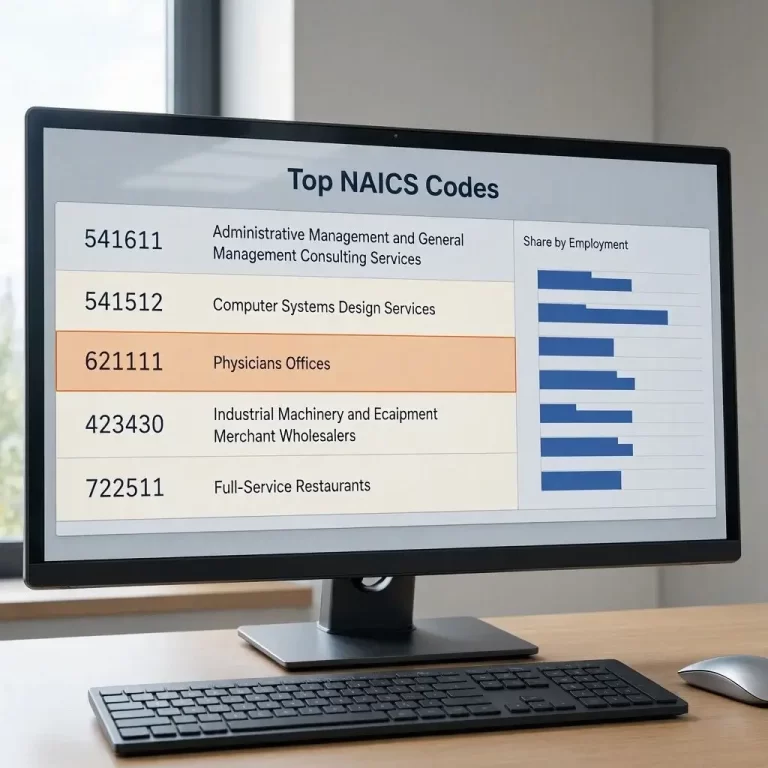
When applying for commercial lines of credit, precision with industry codes is vital. Underwriters evaluate risk profiles based on NAICS classifications.
- The 541611 Advantage: Administrative and General Management Consulting is typically viewed as a low-to-moderate risk industry compared to construction, trucking, or retail.
- Consistency is Key: Ensure that the 541611 NAICS code is accurately recorded with the IRS, state filing offices, and business credit bureaus. Misclassification or vague descriptions can trigger automatic rejections from automated underwriting algorithms.
📈 Step 3: Register with Major Commercial Credit Bureaus
Business credit is not automatically tracked the same way personal credit is. A consulting firm must proactively establish its profiles with the primary commercial credit reporting agencies.
- Dun & Bradstreet (D&B): Request a free DUNS Number, a unique nine-digit identification sequence. A DUNS number is mandatory for tracking a Paydex Score, which ranges from 1 to 100 and measures payment performance.
- Experian Commercial & Equifax Business: Open accounts with banks and vendors that report to these bureaus to build the firm’s Corporate Financial Stability Score and Credit Risk Score.
➡️ Step 4: Open Net-30 Vendor Accounts (Tier 1 Credit)
The fastest way to get positive payment history reported to commercial bureaus is by working with starter vendors. These companies offer “Net-30” terms, meaning the firm has 30 days to pay for an invoice after receiving goods or services.
Look for office supply, shipping, print, or digital service vendors that explicitly report to Dun & Bradstreet or Experian Commercial without requiring a personal guarantee (PG).
- Action Plan: Place small, necessary operational orders monthly.
- The Golden Rule: Pay invoices 10 to 15 days before the due date. In commercial credit, paying early is the primary way to achieve a perfect 100 Paydex score.
🌟 Step 5: Graduate to Tier 2 Revolving Lines and Business Cards
Once a firm has 3 to 5 reporting vendor lines, its business profile will generate an active commercial credit score. At this stage, the company can scale up to Tier 2 credit.
- Corporate Credit Cards: Apply for business credit cards issued by major financial institutions that report solely to commercial bureaus rather than personal credit reports.
- Utilize High Limits Responsibly: Business credit lines often feature much higher limits than personal accounts. Maintain a low credit utilization ratio (below 30%) to signal excellent capital management to future enterprise lenders.
🔎 Step 6: Maintain Continuous Monitoring and Compliance
Building business credit is an ongoing operational process. Protect the firm’s financial reputation by implementing these operational habits:
- Monitor Credit Reports: Regularly check business credit profiles to spot inaccuracies, unauthorized inquiries, or reporting errors.
- Update Public Records: If the consulting firm relocates, changes its name, or shifts its core leadership, update corporate filings immediately to keep public data uniform across all digital and financial environments.